Category: Teen Girls

Never Leave Home Without Good Character Traits

Good character traits are paramount when it comes to overcoming pressure or challenges. It’s the difference sometimes in whether to give in or stick to our own values or whether to give up or keep it moving.

With the unprecedented pressures on teenage girls nowadays, I am delighted to hear of the return of emphasis on character building. The first podcast in our new series, with Paralympian Elizabeth Wright, who advocates character building throughout schools in the UK, deals with the topic. It is out May 15.

Meanwhile, talking about character building brings a breath of fresh air to the debate on how to address some of the modern-day pressures we all face. Sadly, for some time now personality traits have served as the moderator for what is acceptable and what is not.  And when someone is either out of character or displays bad character traits, we often hear: that’s just the way she is.

Call me old fashioned but I call it bad company, bad character. Surely, it is unreasonable to pass off unkindness, rudeness, disloyalty and the lot as just the way someone is.

When I was growing up, I think the emphasis on character building was still on trend, if you will. It might have been losing its steam, but I knew the importance of good character traits in not only building good solid relationships, but also in achieving success in any undertaking.  Another story on whether I always displayed good character or not, but I did understand it.

If I wanted my parents to trust me, then I had to be honest and if I wanted my friends to trust me, then I had to be loyal. And the one time in my teenage life (surely there have been others) when I wasn’t loyal, I suffered painful emotional consequences seemingly for ages. I won’t go into the situation and hope others involved have long since forgotten, but this betrayal of sorts called my integrity into question. All I will say is that there was a popular boy involved. Never mind.

Anyhow, not only did I take a harsh fall from the throne of grace in the eyes of a friend or two and possibly a relative, I crashed landed in my own mind’s eye. It took years to rebuild my own self-esteem and to forgive myself for the deed, even if it was small. But the point is this: without integrity, I might have never known that I was out of character. 

Good character traits can and often do serve as a radar in relationships. Also, good character traits can see us through an achievement and aid us in the worst of times.

When it comes to achieving, I’ve always been slightly above average and slightly below excellent, but where I sit in the great in between is powered by my character traits of perseverance, optimism, reliability, conscientiousness and self-discipline to name a few. Though I wouldn’t take nothing for my journey, there are bits about it that I didn’t really appreciate–having to go to choir rehearsal every Friday night (okay one or two out of the month), lead a song when I could not sing, and attend Sunday School every Sunday morning and participate in the discussions.

But these activities, like them or lump them, fed into my character and drove me to pick up the phone as a young media specialist in New York City and pitch a story, even if I did dread it; sing from a stage in Poland to an audience, who insisted I had the voice of Whitney Houston until they heard it in song; do the right thing in enormous sticky situations, although I didn’t always feel like it; and most recently dig deep and speak up on a overcrowded broadcast platform, when I felt a bit mismatched.

Through these experiences and others, I have come to learn over the years never to leave home without my good character traits. As for the bad ones, I’ve resorted to waiting awhile to keep them in check and I must say the benefits have been enormous.

UIO Launches Wait Awhile For Teenage Girls

UIO, the podcast for teen girls, launched our  Wait Awhile initiative, to encourage teenage girls to slow down and reclaim their teenage years to avoid unnecessary regrets. For years now, I have watched the world of teenage girls change rather radically.  I had suspected for some time that due to modern day pressures, girls were being sexualised earlier and earlier, narrowing the gap between being a girl and a woman.

Our Wait Awhile survey not only confirms my concerns but also reveals the hidden story behind the trend that is seeing an increase in pressures such as sexting, tattooing, cosmetic surgery and missing out on real life experiences and often with regret.

In our news regularly now, we are hearing and seeing tragic stories about self-harm and even suicide. Much of the pressure does come from social media but social media does not happen in a vacuum.  Teenage girls tell me that this notion of being perfect and happy all the time is impossible to live up to on and offline and to try, whether it is by filtering photographs online or trying to fit into an uncomfortable space offline, requires great compromise and can therefore cause unprecedented stress and anxiety.

UIO, through our podcasts and our Wait Awhile initiative, want to relieve girls of this undue pressure. Admittedly, the teen years have always been a challenge but the modern day pressures for girls are unprecedented.

We want to hear from you–teen girls and have provided a platform on our page for you to talk about your experiences, tell us how we can help and how others can help, too.  One thing we are already doing is supporting The Telegraph’s statutory duty of care effort to be imposed on social media companies to better protect children from online harms, as related to teenage girls.

Keep watching this space for more on Wait Awhile, you can follow us on Twitter (@uiowaitawhile). And if you missed it, you can catch up with my recent BBC television appearance on the Victoria Derbyshire show on 23rd April 2019 via iplayer until mid-May.  As always, it is all about you, the teenage girl.

New Podcast Series Coming In May

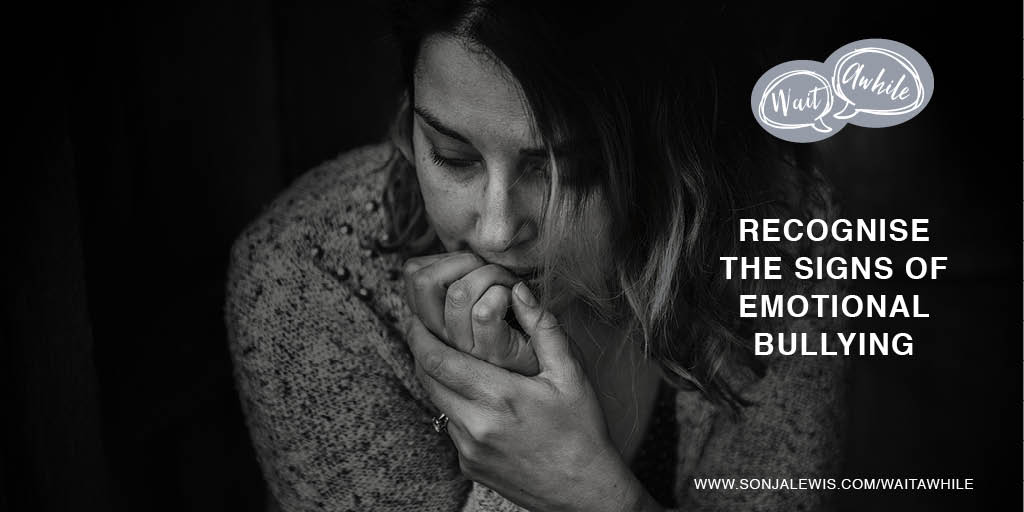
As we prepare for our third podcast series to launch in May, I find myself preparing show notes on some rather tough subjects, one of them emotional bullying, a topic that is as elusive as it is complex.

Unfortunately, emotional bullying is likely the most common form of bullying because it wears so many different hats. Think of verbal abuse, social exclusion, spreading gossip and rumours, telling lies, name calling, backstabbing, betrayal, etc.

Health Direct, a website of the Australian Government sums it up as one person maintaining power or control over another person. And though there are varying definitions that link bullying and abuse to relationships, the point is: bullying is destructive and damaging whether in an intimate close up relationship or a distant one.

A key theme about emotional bullying is that it is repetitive. And according to the Positive Parenting Center’s website, the older girls get the more prevalent it becomes in their lives.

Make no mistake about it, however, emotional bullying is not just a girl thing.  It is something that can and does happen to any and everyone, regardless of background or age.  It just so happens that some statistics in the US show that physical bullying drops off somewhat for girls as they get older and emotional bullying increases.

Sadly, bullying makes its way into adulthood all too often.  I have far more memories of possibly being bullied in the workplace than I do at school. One of my first bosses was definitely an emotional bully, who attacked my work repeatedly and threatened to fire me, after I pointed out a clear matter of discrimination.  A close friend had a similar experience, though the attack on her came out of nowhere, causing her to change the course of her career.

Both experiences had mental and emotional consequences but thankfully we both saw the problem for what it was and managed to put a stop to it, which isn’t always the case.

Thinking back to my school days, however, unless bullying got physical, it wasn’t always called what it was.  That is the thing about emotional bullying; it is ambiguous and hard to stamp out for that very reason.  It is without the physical bruises, but the scars are there, if only the target feels them.

I have hazy memories of a particular student emotionally bullying certain kids on the school bus. I did my best to avoid the person but because this person didn’t have the mythical hallmarks of a bully, there was no proof in the pudding that the taunting was taking place, even if the person only poked and prodded with words– threats and lies.  And when all else failed, it was easy to spread rumours and gossip and forbid followers to hang out with the target.

In those days, help didn’t seem to be a stone’s throw away, though it likely was. Bullying wore a mask and in some ways still does. However, nowadays, the mask is being ripped away. The key is to recognise bullying for what it is and get help as soon as possible whether that means talking to a family member, close friend, teacher, someone you can trust.

And do check out past podcasts, all on our website, particularly On Dating Inside Out.  Again, watch this space:  our new series of UIO, the podcast for teen girls,  is coming in May with a great line up of guests, including a Paralympic three-time medallist, a popular radio personality, and a media entrepreneur creating opportunities for teen girls.

Putting The Spotlight on Reclaiming Sacred Space

When unhealthy change comes fast and furious, we see it for what it is but when it comes slow and subtle, particularly if it is seductive, we tend to turn a blind eye to it, until it causes an explosion of sorts. 

That is what appears to be happening in the world of teenage girls—the pressures that are staring them in the face daily are causing widespread concerns. 

To no direct fault of their own, girls are a part of a values shift in society and when values shift, so do norms, mores.  Normalising non-medical cosmetic surgery, for example, even if unintentionally, is a little bit more than a trend. It has fundamental implications for mental and emotional health, as does lowering the bar for when teenagers are given a green light so to speak to engage in sexual activity freely, for example, without reference to emotional and mental health.

Our Wait Awhile research as featured in The Telegraph’s ‘Thousands of girls as young as 13 turn to cosmetic surgery as social media pressures mount,’ alongside The Sunday Times’ recently published ‘Teenagers line up for Botoxjabs to mimic celebrities,’ turns the spotlight on the concern for girls signing up for non-medical cosmetic surgery.

Both pieces, as does our research, begs loads of questions.  What does it all mean? Who is to blame? Is this a trend? Over the past few weeks, not only have I been asked these question time and again but also, I have pondered them. And while the answers will hopefully come in insight and debate over the next little while, followed by lasting solutions, rather than in finger pointing and casting blame, we have something to celebrate.

The cat is out of the bag. This is a hidden story that has haunted me for some time now.  As a longstanding advocate for providing safe platforms for girls, I have been long concerned about the shifting norms we all face nowadays, and particularly the impact this shift has on teenage girls.

For too long, society has turned a blind eye to the mounting pressures that teenage girls are facing because of our obsession with instant gratification, glamour and glee.  It is quite easy to chalk it all up to generational trends and believe that girls, themselves, are setting the trends and leading the way.

But let’s face it, teenage girls, like the rest of us, don’t live in a vacuum.  They are not exempt from this chaotic state in which we live.  

Actually, there is nothing wrong with any of the above concepts unto themselves—a little instant gratification from time to time can do wonders for  self-esteem but when we feel entitled, that is another story.  And on beauty, it has to be the most misused and misunderstood word of all times. Okay maybe liberal takes the cake.  But the point is this: beauty is a wonderful thing. When thinking of and speaking of creation, itself, beauty sums it up.  It is when we set and subscribe to aesthetic standards that isolate and marginalise some and that we simply cannot measure up to that we end up compromising something emotional and mental, which leads to the rise in frustration, unhappiness and all the rest.

It is not bad thing that we are now seeing these stories out in the open, which have often been unknowingly validated, feeding into the continuing shift in our values, which dictate our norms.

So what can we do? See the new direction for what it is and advocate on behalf of and support the most vulnerable groups and communities in society. And aid them in setting the record straight and reclaiming their own sacred space.  That is what UIO, the podcast for teen girls, inclusive of our Wait Awhile initiative, is all about. Join us and have your say via Disqus, our comments platform or contact me directly here .


Keys To Good Family Relationships

Having spent a weekend with family, I was reminded of how dependent small children are on their parents and guardians for survival. Sure, they exercise a bit of independence, choosing their own outfits and making clear what they prefer to eat and so on but at this tender age, children are not mature enough to decide on their own bedtimes, for example, or how long they should stay glued to a television or an Ipad. Left with them, they would stay up indefinitely and pay the consequences later.

Very few would debate the importance of having a pragmatic relationship with small children but as we grow, the balance of power becomes unclear.  Maybe it is the word power that throws off teens and parents alike.  I know when I was a teenager, I dreamt a world of freedom and independence. It was only when I started working and paying my own bills that I realised how free I had been, of course, within the family unit.

Upon reflection, the world around me had a lot to do with my idea of freedom. For example, if Mary Jane (there was no Mary Jane in my graduating class) was driving at 15 and got a new car at 16, then I reasoned that I had a right to do the same.  My parents didn’t quite see it that way. And once they let me know their views, the story ended or did it.

It did as far as they were concerned but in my mind’s eye, I couldn’t wait to grow-up, so I could jolly well buy my own shiny new car as and when I pleased and have exclusive power over my own life.

Of course, as a young adult, I learned rather quickly that there is a complex line between desire and attainment, that reaching a certain age doesn’t make you all powerful so to speak or give you freedom.  Actually, it is quite the opposite. It was having healthy boundaries and good family relations that gave me the freedom to grow. 

Without those key elements, I feel certain that I wouldn’t have had the confidence to move to New York and then London.  But what makes good family relationships.  Helen Lewis, guest in our podcast, Your Family Inside Out, offers many hot tips.

One key is effective communications. That means sharing your views calmly and clearly.  And this doesn’t stop with young adulthood.  Even now as an adult, I find this advice sound.  Otherwise, the problem does not get resolved. It gets escalated.

Another key element in good family relationships is respecting boundaries.  All families have them, regardless of the age of the family members. Naturally, however, boundary lines change as we grow older.  As a little girl, I wouldn’t have been allowed to ride my bicycle to the store but as a teenager, I could.  No wonder I jumped to the idea of driving ever so quickly. Never mind!

The point is: each family is different and has a different rhythm that they harmonise to and no matter what our age , it is important to have open, honest and effective communications and to respect the boundaries that are often in place to protect us, afford us the freedom to grow not only physically but emotionally and mentally, as well. For more information, listen to UIO, the podcast for teen girls.

The Power Of Self Talk

With the re-release of our first ever podcast, UIO: Your Confidence Inside Out with Cheryl Grace, I’ve been thinking a lot about the power of encouraging words and the impact they have on building self-confidence.  In the podcast, Cheryl points out the importance of positive self-talk.  Don’t say things to yourself that you wouldn’t say to a good friend, someone you respect.

Out with the ‘I can’t do anything right, I am a complete failure, I’m stupid and so in.’  And in with, ‘I can do this. I am good enough and so on.’ This is a truth that I have not always understood but upon reflection, negative self-talk definitely influenced my confidence, hence some of the decisions I made earlier in life.

For instance, when I was a teenager, I bought into the old saying sticks and stones may break my bones but words will never hurt me.  In short, I didn’t get into many physical brawls, if any—not much of a fighter but almost always there was a war of words going on with another person or inside of my head, whether it had to do with not liking my looks or not thinking I was good at something like standardised testing.

On the latter, I now know it was believing in discouraging words of others and the negative self-talk that stood between me and my confidence to crack the tests.  Following the first low score I received on the Preliminary SAT/National Merit Scholarship Qualifying Test (PSAT), I took a big hit in the area of self-esteem.

Until then I had been pretty evenly matched with those around me, those in my class, in literal arts subjects in particular. Admittedly, I started lagging behind others, mainly boys in Maths around fourth grade. That was the year of integration of the schools in the US, which is an entirely different story to be told another time but does have commonalities with this one, regarding encouraging and discouraging words. Know the power of both.

Anyhow, back to the PSAT, there was the smart boy, who most likely was a genius, who was miles ahead of everyone, who achieved an unbelievable score but I had not necessarily felt inferior to him or any of my other peers until the first low score came, which influenced my standing with teachers and peers, their outlook on my future.

Though I can’t remember a moment where I sort of shrank within, I remember vividly losing confidence, feeling less than others and going into over drive on negative self-talk. This denigration of myself combined with being told that I would need to dream smaller about college and university would haunt me for years to come.

For years as a writer, I didn’t have the confidence to believe in my views, even if they were rejected widely. Thus, I started hating constructive feedback and really didn’t grow as a writer until I started believing in myself again. This began with other wonderful writers and acquaintances propping me up and encouraging me to get on with it. I had a gift.  Then I started sharing my work and reminding myself all the time that I had a gift and even if big publishers didn’t see it, I would still write a novel or two, maybe even three.  We’ll see about that one.

Anyhow, the point is this:  don’t underestimate the power of encouraging words, not only from yourself but also from others.

Discouraging words can be a confidence buster whether from you or from others. Where you are in control, remember that negative self-talk is denigrating and limiting and positive self-talk is affirming and inspiring.  That is why affirmations are so powerful. Stay positive.

And when others speak negatively to you, don’t believe them.  Keep in mind that it is hurt people who tend to hurt others and during the teen years, life can be fast and furious. Sometimes it pays to stop, think and wait awhile before saying things to yourself that will not serve you or take on board the negative words of others.

As for that old saying about sticks and stones, don’t believe it!  Words are powerful and not only can they defend you, they can also offend. For more hot tips, check out UIO, the podcast for teen girls. 

Celebrating Your Girl Super Power

Though women and teenage girls are experiencing unprecedented pressures to be perfect, to be happy all the time, we girls remain amazing and there is no better time to be a woman, a girl and to celebrate.

Celebrating womanhood is appropriate any time of the year but during March, Women’s History Month, honouring and celebrating women is a daily event, not to mention the excitement of International Women’s Day, March 8.

Appropriately so, we have re-released our Identity podcast, a wonderful celebration of identifying as a female.  Sisterhood co-founders Rachita and Rebecca talk about the wonderful girl cell that we ladies have.

“The girl cell is your super power. “

Ever since I heard this emancipating statement, I have been in fifth gear, encouraging teenage girls to reject the modern pressures in their lives, posing as necessary, norms that will serve them now and forever more.

Hence, our wait awhile initiative, starting its third week of life. With alarming statistics revealing that some teenage girls are actually getting non-medical cosmetic surgery, I have had endless conversations and queries about the matter. How can this be happening? Are these procedures legal, etc?

One growing concern I have is that the real point of this statistic–teenage girls are being forced to grow-up too soon– is lost on society. It some ways it appears that the story is yet another sensational piece, detaching it from real girls.  Not so fast!

The reality is that real teenage girls have had their lips done several times to make them bigger, had fillers in their mouth so gums don’t show when they smile, fillers in their nose so they can contour it, had numerous injections in their bottoms, and Botox from the age of 16.

This is real life, not reality television, impacting the lives of a generation of girls who are making these choices under pressure, often blaming the social media culture in which they live. Social media has a lot to answer for, which is why we are supporting The Telegraph’s duty of care campaign and calling on the Government with as many strokes of the pen as we can to make social media a safe space for teenage girls.

But social media alone is not the only problem. Our girls are growing up under the influence of modern pressures on and off media. Our research corroborates that some of the pressure are systematic, if you will.

So change is needed inside, out if you will.  Meanwhile, we are saying to teenage girls: embrace your girl cell, your super power, use it to strengthen your identity. Follow your passions and side step things that will likely lead to regret and enjoy the good stuff about being a girl and as for the good stuff about being a woman, await awhile. It will come.

For more tips on identity, check out Your Identity Inside Out and tap into your girl cell, your very own superpower.

Reaping the Benefits of Waiting Awhile

One of the stories found in our Wait Awhile research confirms that teenage girls still feel a lot of pressure to explore sex, often before they are ready. Of the 16% of our respondents who said they had gone further in a sexual relationship than they were comfortable with, 77% of the girls said they regretted doing so.

And although our survey doesn’t ask girls to tell us the specific regrets, I know from talking with teenage girls through my work and personal life and having been a girl myself, though a long time ago, such regrets are deeply felt and can be long lasting, which is why our Wait Awhile initiative is about taking a deep breath and widening the gap between being a girl and a woman.

Having said that some high risk activities for teenagers, such as sharing sexually explicit material can lead to danger and harm and deep regret at any age. But becoming sexually active prematurely does carry enormous risks during the teen years.

There are plenty of reasons to wait awhile but too often the only reasons that are expounded on are the ones that focus more on the negatives consequences of premature sex instead of the positive benefits of waiting.

At UIO podcast, we believe there are enormous benefits in side-stepping undue pressures and expected behaviour that could result in deep regret. And we are not just talking about sex, though sex is a big deal. Sexuality, for example, is another topic that teenagers feel heated pressure to explore and know all the answers instantaneously.

In our On Dating Inside Out podcast with Cat Williams, the therapist points out that often when we are determined to do something no matter the cost, it might not hurt to step back and let the hormones settle, my words, not Cat’s.

Amongst the benefits of stepping back are living a life without the pressure of worrying about consequences, as well as the opportunity to align with your true values and live your best life in the here and now.  And as you grow-up that here and now changes, as it should, giving you the opportunity to make more informed decisions that serve you, rather than cause regret and grief.

In our On Sex and Sexuality podcast, which we have re-released this week, our guest Rachel Gardener talks about the importance of putting your relationship first, before diving into a steamy romance. The benefits of learning loads about yourself while learning to relate to another person far outweighs living under pressure that can and so often lead to physical and emotional scars.

Waiting awhile is about reclaiming your space as a teenage girl.  After all, you’re only a teenager for a few short years. Enjoy!

What Dating Has To Do With Self-Discovery?

When we talk about dating, we often hear about either the romanticised version of it—finding a happily ever after—or the complexities—not finding a happily ever with all the pitfalls in trying too.

There must be a somewhere in between, right! And as I think back to my teen years and consider the insightful information from relationships counsellor Cat Williams in our latest podcast, UIO: On Dating Inside Out, I’ve had a lightbulb moment.

This middle ground must have to do with self-discovery. Great, you might tell yourself. I think I know a bit about me. Of course, you do. But here is the thing: anytime we venture into something new, there are oodles of opportunities for growth and in this growth, we often have revelations, that we might not have otherwise discovered.

And with these revelations, if you don’t like them, you can use the experience to change. And if you do like what you learn, use it to get even better.

Thinking back to my teen years, I had a few experiences that fit the bill. It took me only once to discover that I didn’t like the idea of someone believing he had the right to touch me because we were dating. At a basketball game, my boyfriend thought it would be a good idea to sit behind me, giving me little choice but to lean back on him and from there he proceeded to touch me completely inappropriately.

First of all, I felt humiliated and then mortified. I hadn’t had any physical closeness with him and had no intentions of doing so. Yet he assumed that he had the right to touch me. What gave him that idea? What does he think of me? Next, all I could think was if my mom and dad hear about this, there goes my cheerleading days and rightly so. Somehow, I wriggled out of the tortuous situation and broke off the relationship at the first opportunity, probably the next day. But what I didn’t do was tell him why I broke it off, at least I don’t remember telling him.

So, what did I learn? First, there was the bit about self-confidence. I didn’t have the confidence to speak out on the matter, then and there. This came as a shock to me because I had no problem speaking out at home. Next, I learned how important reputation was to me and still is. In addition, I learned about the importance of family. I felt that I had somehow violated a trust between me and my parents. And it suddenly dawned on me that I wanted to be a trustworthy person, not only with my parents but in general.

For years afterwards, I had a guilt about the experience with loads of questions. Why did I let it happen? Why didn’t I do something about it, then and there. Why did I think it was something I did that made him behave badly and so on? And later, as I was talking to an acquaintance who was in her teens about the experience, I recounted the positive lessons I had taken away, too. I remember how moving forward I escaped such situations by taking responsibility for where I sat and how I sat.

And I left school with my good name in-tact and with my family values in tow and a desire to go off to New York City someday. And I did with the lessons of confidence and much more close to my chest. Fast forward all these years later and I am still learning from the experience or re-learning, that is.

As Cat Williams points out in On Dating Inside Out, objectification has nothing to do with the person being objectified, nor does bullying. What has to do with you is how you handle it. It’s all about self-discovery. For more hot tips, check out the podcast on iTunes as well as Soundcloud or subscribe on this site to hear more about how to navigate dating for the best possible outcomes right in the space you are in. Oh and yeah, don’t forget to have fun. A lesson I stumbled upon, too.

Accessing Your Power Toolkit In the Eye Of A Storm

If I could magically make all hurricanes, cyclones, tropical storms, tsunamis disappear, I would do so instantly, and I am sure I’m not the only one. With an onslaught of activity pre-season and during season, I am feeling a bit frazzled to be honest.

Last night as Hurricane Michael battered the very city where my father and all of my sisters and most of my nieces and nephews reside as well as many relatives, I felt anxiety get its grip on me. Having been in touch with my father via FaceTime until the lights went out literally, I quickly gave into the dreaded anxiety.

But instead of remembering that it all starts with a menacing thought, I just kept on thinking and second guessing whether my family would be safe or not, whether Albany, Georgia, would even be a city by morning. Thankfully I only focused on one city, though you might say this was selfish thinking, when so many lives were and still are at risk. But let’s face it, I am only human, and it was this focus that kept me from a complete melt down. Imagine if I had thought the Florida panhandle, Southwest Georgia and so on would be totally ruined, how my night might have gone. It could have been worse.

Make no mistake about it, it was bad. After a bit of frustration with the delayed progress of CNN and The National Weather Channel, I happened upon the local television station—WALB. Viola! At last I received consistent communications and interestingly my thoughts begin to calm down. It was in this instance that I, from the outside, could see how bad the storm, if you will, actually was and could then send my family, who are held up in secure areas of their houses, text messages telling them that though the Hurricane was still dangerous, it had gone from category four to three and then to two.

And when I got a few pings back, I had a big sigh of relief but not quite big enough. But it was enough relief to access my power tools for abating anxiety, which was well on its way to panic. The first tool for me happens to be prayer and it works a jewel but to be able to pray peacefully and mindfully, I have to do a bit of practical preparation, which leads to the second tool—shutting down my devices. How very practical.

You might remember in Your Online Wellbeing Inside Out that guest Nicola Morgan suggests signing off at least one hour and thirty minutes before going to bed even in the best times. And here I was in the worst of time, glued to WALB on my iPad. It was nearly 2 a.m.

So, I sent the last text to Daddy and sibs and off the devices went but admittedly, I did stash them nearby instead of in another room as advised. Then I commenced to prepare my mind. In our latest podcast, Rising Above Odds, Hannilee Fish talks about the importance of mindfulness, staying in the moment. So tactfully and gently I reminded myself that I was in London, England, in my bed and not in Albany, Ga, and none of these horrible things that I feared had actually happened.

And only then did I remember a hot tip from Eleanor Segall, our guest, from our second podcast, On Undiagnosed Mental Illness—talk to someone, don’t keep the stress bottled up. I looked over at Paul, who seemed asleep and decided against talking to him, so I talked to God. Good idea and found myself being grateful for the strength to support my family during a stormy time and the actual mental and physical capacity to take care of myself. Off to sleep I went if only for a couple of hours.

As I reflect upon the episodic night, I am so grateful to the women of UIO for sharing their experiences, the good and the bad. What a wonderful tool box to go to in the time of need. So glad I had it not only at my finger-tips but in my thoughts, too.

And the biggest lesson I learned had to do with managing me when I had no control of managing Hurricane Michael, precisely the tip from Cat Williams, guest of our next podcast coming up in late October, On Dating Inside Out. Author of Stay Calm and Content No Matter What Life Throws At You, Cat knows a thing or two about keeping cool in the eye of a storm, okay so I wasn’t in the eye, but it sure felt like it. Stay tuned!